
Introduction
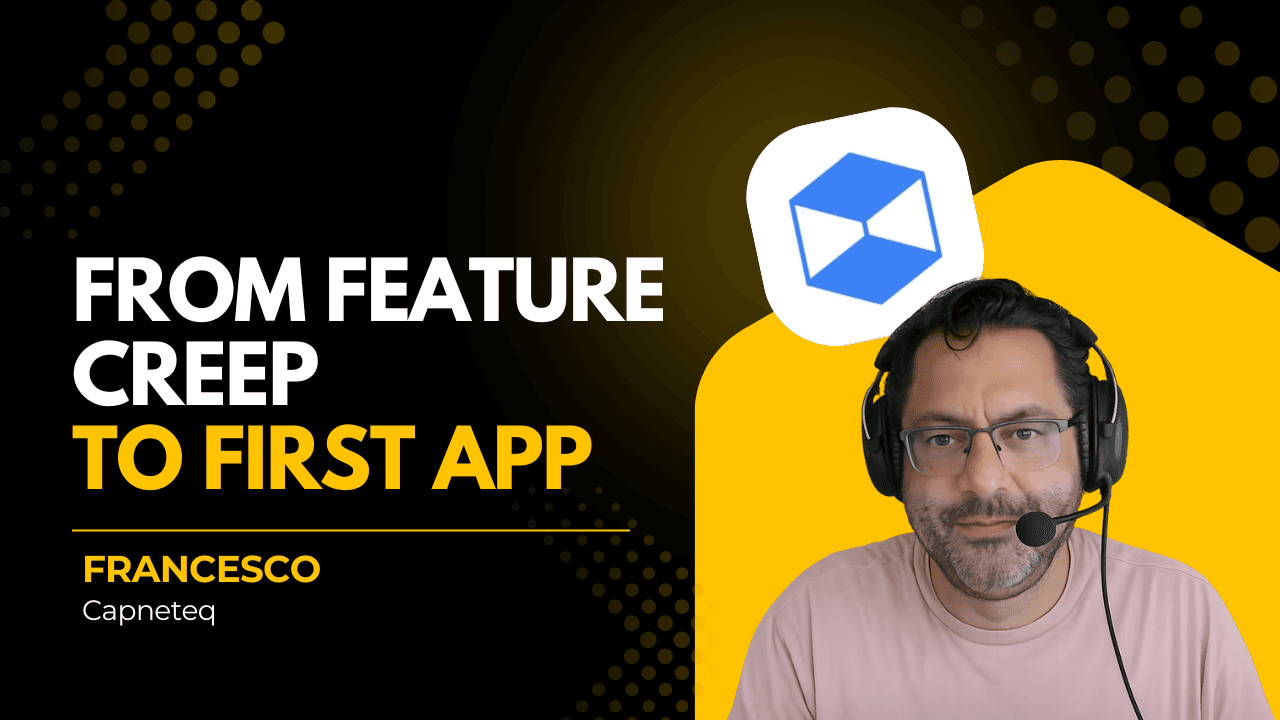
Francesco is a materials engineer with 10+ years in the industry.
Worked for Olympus (yeah, the camera company) for 7-8 years. Then moved to a German biotech company.
He knows the scientific instrument world inside and out – the million-dollar equipment collecting dust in university labs, the grad students who need money, the startups desperately searching for instruments they can't afford to buy.
He had the perfect idea: an Airbnb for scientific instruments.
Connect the industry with universities. Help broke grad students make extra cash while giving startups access to the equipment they need.
The idea was solid. The business case was clear. He even had a co-founder in Toronto.
So he started building.
And building.
And building.
For a year and a half 😴
Francesco had already finished my React Native Mastery course. He knew how to code. The app was 70% done – already on TestFlight, Firebase backend working, React Native frontend looking good.
But he couldn't ship it.
Why?
Here's where Francesco was stuck
1. Feature Creep
Every week, he'd think of something new:
"Oh, this needs a marketplace feature where people can buy equipment, not just rent."
"Wait, I should add a social hub where users can post jobs and share tutorials."
"Actually, I need an AI assistant to help people find compatible equipment."
"And what about a compatibility checker tool?"
"And a depreciation calculator..."
You see the pattern? 😅
The app wasn't a focused solution anymore. It was becoming a monster with ten different features, none of them polished, all of them competing for attention.
Classic developer trap: when you know HOW to build, you keep building instead of shipping.
2. The App was slow
Load an equipment list? 7.5 seconds.
Why? His backend was fetching 2,000 items from Firebase, manually filtering them in JavaScript, manually sorting them, then returning 20 items to the user.
The database was doing nothing, and JavaScript was doing everything. It was Backwards.
3. Unclear launch plan
Was it a marketplace? A social network? A search tool? All of it?
When you try to be everything, you end up being nothing.
4. He was alone
No accountability. No deadlines. No one to tell him "STOP ADDING FEATURES AND SHIP THIS."
Just him, the code, and an ever-growing to-do list.
How we turned this
Francesco almost joined the year before but missed it. When the 4th cohort opened, he jumped immediately.
"I needed structure," he told me. "I needed accountability. I needed someone to tell me to stop."
So here's exactly how we broke through each problem:
Problem 1: Feature Creep → We cut ruthlessly
First week, I looked at his app.
"Francesco, what's the core problem you're solving? Finding instruments to rent? Or buying equipment? Or a social network?"
"Well... all of it adds value..." he said.
"No. You're confusing users. Pick ONE thing."
We killed the marketplace. We killed the social hub. We killed the AI assistant. I know - sounds sad 😢
The app went from:
🔴 trying to do 10 things poorly
🟢 to doing 1 thing well.
Just find instruments. That's it!
Problem 2: slow performance → we fixed the architecture
I watched him load the equipment list, and we waited a painful 7.5 seconds while the app struggled to display anything 😅
We dug into his code together and found the problem: his backend was fetching 2,000 items from Firebase, then manually filtering and sorting everything in JavaScript before returning just 20 items to the user.
I told him he was doing it backwards – the database should do the heavy lifting, not JavaScript.
Next week? Under 1 second load time 🏃♂️💨
We also switched his map from React Native Maps to Mapbox. He was hesitant because he'd already built everything.
"Trust me," I said. "It's worth the migration."
He did it. The difference was night and day – smooth panning, stable markers, no lag.
Problem 3: unclear launch plan → we focused the strategy
"What pages need to be public? What goes behind sign-up? What's your SEO game?"
We figured out his distribution wasn't going to be App Store search – it's B2B and hyper-niche.
Scientists don't search "microscope rental" on the App Store.
They Google it.
So we doubled down on SEO: free tools, programmatic pages, website optimization.
His Google Search Console rankings jumped from position 261 to the first page for key terms.
The strategy: SEO feeds the website. Website converts to app downloads.
Problem 4: no accountability → weekly check-ins and pushback
Every Monday, Francesco had to show up and report progress.
Not to judge him. But to keep him moving forward.
When he got stuck, we jumped on calls. When he wanted to add features, I pushed back. When Apple rejected him (twice), we debugged it together and resubmitted.
He wasn't alone anymore.
And he wasn't building in a vacuum – he was in a group with other founders hitting the same walls, sharing tools, pushing through rejections together.
Around week 7 of the Incubator, he launched 🚀
Apple approved the app! 🥳
Francesco sent me a message: "WE'RE LIVE."
From 18 months of solo grinding to 7 weeks of focused execution.
Was the app perfect? No.
Did it have every feature he dreamed of? No.
But it was on the App Store. Live, available, and getting users.
What Francesco learned
When I asked him what changed, here's what he said:
"Be careful with feature creep. We're developers. We like to build. It's very easy to keep adding the next feature, the next feature... and it destroys your timeline."
He learned to see his app as a business, not just a coding project.
He learned that launching with 60% is better than never launching with 100%.
He learned that seeing other founders struggle and push through made him feel less alone.
He continued: "The most valuable thing? Knowing that other people are experiencing the same thing you are. When things aren't working out, it's very easy to feel down. Seeing others pushing through – that was huge."
Francesco's advice: "Just do it. Don't overthink it."
When I asked what he'd tell someone on the fence about joining:
"Just do it. Don't think about it. Don't overthink it."
He added:
"This program isn't for complete beginners. It's for someone who already has the basics down and needs help with the business side. How to handle the App Store. How to handle rejections. How to actually ship instead of building forever."
Francesco worked 15-20 hours a day before the Incubator.
He works the same hours now.
The difference?
❌ Before: building features no one asked for.
✅ Now: shipping updates based on actual user feedback.
Let’s do this!
Francesco worked just as hard before joining, but he was building in circles.
After 7 weeks with us, he shipped.
The real learning starts when users touch your app and tell you what's broken, what's confusing, and what they actually need. Not what you think they need.
And yes, I totally understand that you want it to be perfect before anyone sees it.
But the thing is that your app isn't you.
It's just an experiment, something you put out there to see what happens.
Francesco's app is live now, getting real feedback from users, and he's improving it based on what matters.
And that, my friends, is where the fun begins 😁
So let's do this! The next Incubator Cohort is opening soon, and you can APPLY HERE.
- 10-week program to launch your app
- Small group (10 founders max)
- Weekly 1-on-1 coaching when you're stuck, Monday accountability check-ins
- Technical help + business guidance
- Guest expert calls over a cup of coffee
- You keep 100% equity
Turn "I've been building for 18 months" into "I shipped in 7 weeks 💪
P.S. Francesco's app is called Capital Equipment Network. It's live on the App Store right now. From 18 months of solo grinding to 7 weeks in the Incubator. That's the difference accountability makes.