

Introduction
Carles built apps for other people.
But here's what he'd never done: launch something under his own name.
He was always part of a team. Someone else handled deployment, someone else dealt with App Store reviews, someone else figured out ASO. He didn't have complete visibility of what it means to ship an app.
Carles had Mosaic Photography - a website showing 19th century public domain photography. Beautiful vintage work, high-resolution images. 3,000 visitors a month from pure SEO. The website was working. People loved it.
But every time he tried to turn it into a mobile app, he'd get stuck.
- How do App Store reviews work?
- What about nudity restrictions? (His gallery included artistic nudes from the 1800s.)
- How do you write metadata?
- What's ASO?
- What about deep linking, Sentry, Firebase, and revenue models?
"I needed someone to tell me when I was wrong and to be supported by people who really know what they're talking about. That gives you the confidence that you need." - he said.
And in the Incubator, you get more than just my guidance - you're surrounded by people who have the same challenges.
Most of the time, when we start a regular Incubator meeting, we never finish it in time, because the discussions get so good!
We also have guest experts that we invite to chat over a cup of coffee - like Adam Lyttle, who even showed up twice, because one chat was not enough.
Imagine someone who is successful and known, answering YOUR specific questions about YOUR specific problem 😮💨
So let’s meet Carles 👨🎓
Carles is 47 years old and he started coding at 40.
Worked three years at a Berlin fintech startup, then became a contractor for German companies after moving to Chile. At first, it was great - his first global contract gave him three job offers to choose from.
Then the last six months hit different.
Couldn't land new work. Remote positions were drying up.
More competition.
AI changing everything.
Maybe all of it combined?
But there is always a bright side - he had time now. Time to finally build the thing he'd been thinking about for months.
The real problem: knowing how to code ≠ knowing how to ship
The issue was that he never deployed an app of his own. He’s been working in companies with SQL, MongoDB, different backends, but senior developers always took care of deployment.
He never did it.
And the second problem?
He was doing everything alone. Database work, design, marketing, SEO, and customer research. No one to tell him what actually mattered and what didn't.
Carles was stuck in that place a lot of developers know too well: when you're building solo, there's no one to tell you "stop adding features and just ship it."
The Incubator isn't theory. It's not watching tutorials or reading documentation.
It's planning, building, releasing, and seeing your product alive.
It proves that you can do this.
Small wins matter.
Progress checks are what make you see that you're moving forward.
Because when you're building alone, it's way too easy to convince yourself you need "just one more week" or "just one more feature." With Incubator accountability, there's nowhere to hide.
You either did the work, or you didn't 🤷♂️
And that pressure - the good kind - is what makes things happen. For that, we use our internal system that we developed this year. Very simple and clear.
You follow 5 steps: from idea to market, that we divide across 10 weeks:
- Ideation & Research
- Planning
- MVP - core feature
- Pre-launch
- Launch
Every week is planned, kept accountable. Every week you show up - for yourself - and understand where you’re at.
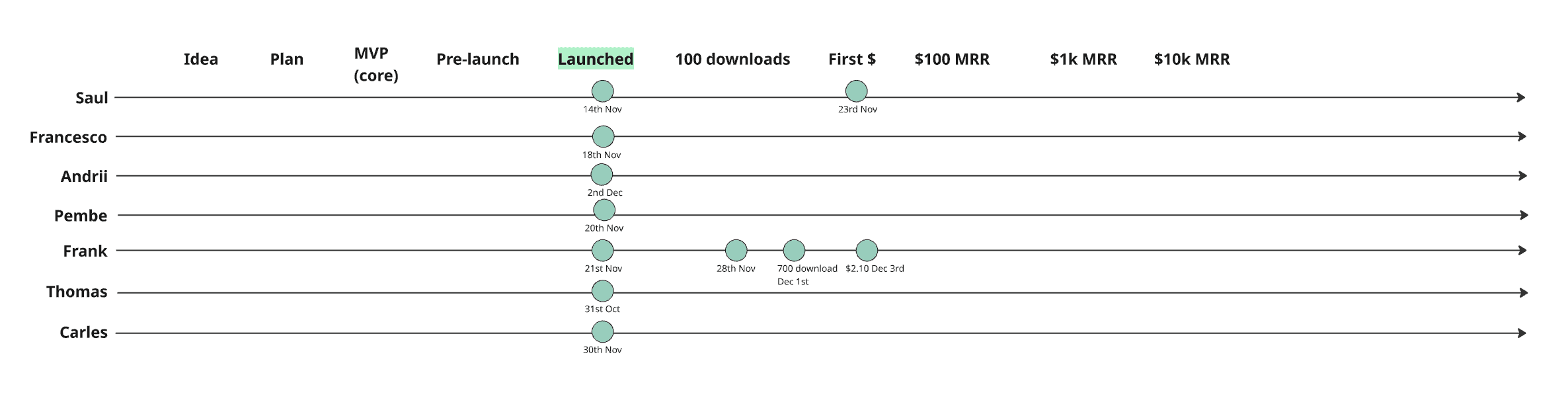
When Carles joined the Incubator, here's how his journey turned out:
Week 1-2: Went all-in on Mosaic Photography. Started building, connected Supabase, got the gallery working, added favorites and collections so Apple wouldn't reject for minimal functionality.
Week 3-4: Hit the Firebase build wall. iOS builds kept failing. Spent $20 debugging permission errors before finally getting it working.
Week 5: Deep linking nightmare. After days of fighting with universal links, he decided to ship without it being perfect.
Week 6-8: Set up both app stores ($125 total), created screenshots on a borrowed MacBook, got 12 Android testers. Submitted to iOS and got approved first try.
Android approved after the 14-day testing period.
Both platforms live within 8 weeks.
Now let's dig deeper into his journey.
The "make it one week" moment
By Week 2, Carles was moving. Gallery working, Supabase connected, favourites and collections planned.
During our Monday call, I asked him, when will you have favorites and collections done?
"Maybe in two weeks."
"Make it one week."
There was a pause.
"Okay. Actually, I can make it in one week 😅 "
And he did.
Just like that! 🤷♂️
After the Incubator ended, he told me:
"I remember that moment. I was like... okay, actually I can do that. But left to my own pace? I would've taken two weeks. Or three. Being a side project, it always happens - I'm doing it when I can, sometimes I can, but I don't feel like it. Here, you are kind of pushed to accomplish things."
That's the thing about building alone.
You give yourself too much time, too many excuses. And the finish line keeps moving.
And that's exactly what the Incubator fixes. Accountability. You can't procrastinate. You have to show up. Every Monday, there's a call. Every week, you're reporting progress. Every step forward is visible - not just to me, but to the entire cohort.
The moment he realized he could actually do this
We hit the middle of the program.
And Carles was showing me his progress. Gallery is working smoothly. Favorites and collections implemented. The authentication flow is clean. Individual photographer pages with timelines showing historical context.
"This looks really good," I told him.
"You think so?" He sounded surprised.
"Yeah. This is solid work."
Carles still remembers when we talked about this moment: "I was doing things in React Native, but unsure if they were the right way. Then all of a sudden you show your project, and you get good feedback, and you say, okay, it can be improved, but actually, I was not very wrong. That gives you the confidence that you need to keep exploring and keep learning new things."
That confidence shift is huge.
Going from:
❌ I think I'm doing this right but I'm not sure
✅ okay, I actually know what I'm doing
And this is what happens when you show up every week with progress.
You're not just hoping you can do this. You're seeing evidence that you ARE doing this.
By week 8, he had his app approved in both platforms.
Carles submitted to iOS first. Approved on the first try! 🤩
"I've never been so close," he said.
Both platforms - live!
68 downloads in the first week on iOS. It was going slow but steady.
✅ But you know what? Slow and steady beats stuck at 70% forever.
What Carles said about the experience
I asked: "If you hadn't joined the incubator, do you think you would have launched in 10 weeks?"
"Not in this short amount of time. Definitely, I would at some point, someday. But doing this in 10 weeks - my next application is going to be 10 times faster."
❗️And this is a very important thing I want you to take away from this:
He learned that launching 1 app fast is not the true gold medal.
Actually, it is to learn do it again and again, better and better.
To find a system and to experiment.
And I am happy that now he is in this place: "Launching the app is the smallest thing I did. I learned a lot, and that remains. It gave me big confidence."
I asked him what was most valuable about the Incubator:
"The support - not only on technical things with code, which is very important, of course, but also in terms of how successful applications in the world really work. How the whole integration in the app stores works. How important ASO is. Even how to pitch for your own project. It's a very complete support."
Also, working together with other people that are in the same spot as you. We're on the same project, and we're just sharing our successes and our failures. That's very supportive too."
I asked Carles who this program is for?
"I don't see anyone who should be out. We are all developers, we're different people with different backgrounds. There's people who have been doing this for 20, 30 years, and then there's people like me. But what unifies us is the passion, the willingness to develop an app that hopefully finds a place in the store.
If you are a developer and you're interested in mobile applications, I don't see anyone who wouldn't do this program. You don't even need to have an idea that you want to publish - you get help on that if you want in the program. I think the main goal of the program is learning and seeing how things are done right."
Then he got specific about who should join:
"If the person asking was a very experienced developer, I would tell them anyway yes, because I know these people are getting valuable things from the program. They will get suggestions, tips on how to market, on how to sell themselves, on how to improve their code even. You can only win."
I asked him if the investment was worth it.
"Of course. I would do it again."
Mosaic Photography is live on both app stores.
He's planning the next version - now he knows how to ship. He's done it once - he can do it again.
The Incubator didn't make it easy. It made it possible.
And if Carles, who started coding at 40, who'd never shipped solo before, can go from stuck to shipped in 10 weeks, what's your excuse?
If you want to join us for the next cohort - apply here.